What Is an Order Block in Trading? | Maven Trading
Written by Emma on August 18, 2026.If you’ve spent any time researching Smart Money Concepts (SMC) or ICT trading, you’ve almost certainly come across the term “order block.” It’s one of the most widely used concepts in this style of trading, and it forms the foundation for related ideas like breaker blocks.
Quick answer: An order block is the last opposing candle before a strong, fast move in price. Traders treat it as a footprint of where large institutional orders were likely placed, and watch for price to react when it returns to that zone.
1. What is an order block?
2. Bullish vs. bearish order blocks
3. Why do order blocks matter?
4. How to identify an order block, step by step
5. Order block vs. breaker block
6. Common mistakes traders make with order blocks
7. Best practices for trading order blocks
What Is an Order Block?
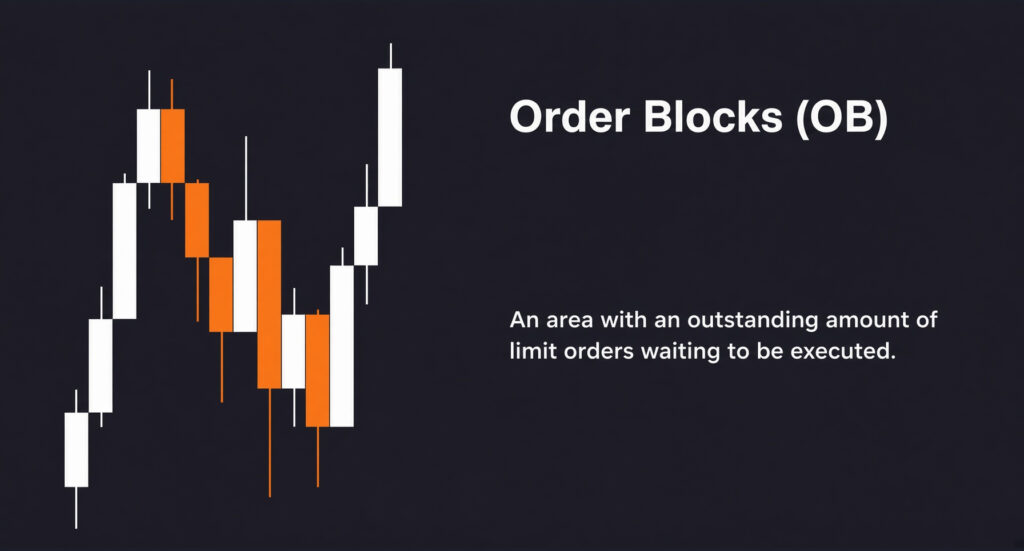
An order block is a candle (or small cluster of candles) that forms right before a sharp, impulsive move in price. The idea behind the concept is that large institutional players — banks, funds, and other big participants — can’t fill their full order size at one price level without moving the market. So they build positions gradually, and the last candle before the market finally breaks away sharply is thought to mark where a large chunk of those orders sit.
For a candle to qualify as a genuine order block, traders typically look for three things:
- It’s the last opposing candle before the move — the last down-close candle before a strong rally, or the last up-close candle before a strong decline.
- It’s followed by a strong displacement — a fast, decisive move away from the zone, not a slow grind.
- It often leaves an imbalance behind — many traders look for a fair value gap forming right after the order block as extra confirmation.
Bullish vs. Bearish Order Blocks
Bullish Order Block
A bullish order block is the last bearish (down-close) candle before a strong move higher. Traders watch for price to pull back into this zone after the initial rally, expecting buyers to step back in near the same level.
Bearish Order Block
A bearish order block is the last bullish (up-close) candle before a strong move lower. Traders watch for price to retrace up into this zone, expecting sellers to defend it and push price back down.
Why Do Order Blocks Matter?
Order blocks matter because they give traders a specific, chart-based zone to react to, instead of guessing at round numbers or vague support and resistance. Because the concept is tied to how large orders are absorbed into the market, many traders use order blocks as a framework for anticipating where institutional buying or selling pressure is most likely to reappear — rather than reacting only after a move has already happened.
How to Identify an Order Block, Step by Step
1. Find a strong, fast move in price — a clear displacement, not a slow drift.
2. Look left to the candle immediately before that move. If the move was up, find the last down-close candle; if the move was down, find the last up-close candle.
3. Mark the high and low of that candle as your order block zone.
4. Check for a fair value gap forming just after the order block — this adds confluence.
5. Wait for price to return to the zone rather than chasing the original move.
6. Look for a reaction (a rejection wick, or a smaller break of structure) inside the zone before entering.
| Tip: The strongest order blocks are usually the ones that caused a genuine break of structure — not just a small bounce. If the move afterward didn’t shift market structure, the zone is much less significant. |
Order Block vs. Breaker Block
An order block is a zone that hasn’t failed yet. If price later breaks straight through an order block instead of respecting it, that failed zone becomes a breaker block — a related but distinct concept where the zone’s role flips from support to resistance or the reverse. See our full breaker block guide for the difference in detail.
Common Mistakes Traders Make With Order Blocks
1. Marking every small candle before any move as an order block, instead of reserving the label for genuine, high-momentum displacements.
2. Trading order blocks on very low timeframes with no higher-timeframe context.
3. Entering the instant price touches the zone, without waiting for any confirmation.
4. Ignoring the broader trend and trading order blocks against the dominant direction.
5. Setting stops too tight, inside the order block itself, instead of just beyond it.
Best Practices for Trading Order Blocks
- Focus on order blocks that align with the higher-timeframe trend rather than counter-trend setups.
- Look for confluence — a fair value gap, a round number, or a prior swing level near the same zone.
- Keep risk small (1–2% per trade); order blocks improve odds, they don’t guarantee outcomes.
- Journal your trades to see which markets and timeframes actually produce reliable order block reactions for your style.
Frequently Asked Questions
Q: What is an order block in trading?
A: An order block is the last opposing candle before a strong, fast move in price. It’s treated as a footprint of where large institutional orders were likely placed, and traders watch for price to react when it returns to that zone.
Q: What’s the difference between a bullish and bearish order block?
A: A bullish order block is the last down-close candle before a strong rally, and traders expect support there on a pullback. A bearish order block is the last up-close candle before a strong decline, and traders expect resistance there on a retracement.
Q: How do you trade an order block?
A: Most traders wait for price to return to the order block zone after the initial move, then look for confirmation — such as a rejection wick or a smaller break of structure — before entering in the direction of the original displacement.
Q: What is the difference between an order block and a breaker block?
A: An order block hasn’t failed yet — it’s the original zone. A breaker block is what remains after an order block fails and price breaks through it, flipping the zone’s role from support to resistance or vice versa.
Q: Do order blocks actually work?
A: Order blocks are a probability-based framework, not a guaranteed signal. Many traders find them useful as one piece of confluence alongside market structure, liquidity, and fair value gaps, rather than as a standalone strategy.
Ready to Put Concepts Like This Into Practice?
Order blocks are easier to understand once you’ve seen them play out on a live chart. Maven Trading gives funded traders a simulated account and a supportive community to test strategies like this. Choose your challenge to get started, or join our Discord to talk strategy with other traders.
Note: Maven Trading provides simulated funded accounts and educational content only. This article is for educational purposes and is not financial advice.