What is a Breaker Block in Trading?
Written by Emma on July 28, 2026.A breaker block is one of the more advanced building blocks of Smart Money Concept (SMC) and ICT trading. If you’ve already learned about order blocks and break of structure (BOS), a breaker block is the natural next concept: it’s what happens when an order block fails.
Quick answer: A breaker block is a former order block that has been broken through by a strong price move (a BOS), which flips its role from support to resistance, or resistance to support. Traders watch for price to return to a breaker block as a potential entry zone in the new direction.
1. What is an order block, quickly?
2. What is a breaker block?
3. Bullish vs. bearish breaker blocks
4. How to identify a breaker block, step by step
5. Breaker block vs. order block: what’s the difference?
6. Common mistakes traders make with breaker blocks
7. Best practices for trading breaker blocks
8. FAQ
What Is an Order Block, Quickly?
Before breaker blocks make sense, you need the basics of an order block: the last opposing candle before a strong, fast move in price (a displacement). Traders treat this zone as a footprint of where large institutional orders were placed, and often expect price to react when it returns to that zone. We cover order blocks in full detail in our order block guide — this article assumes you have that basic picture.
What Is a Breaker Block?
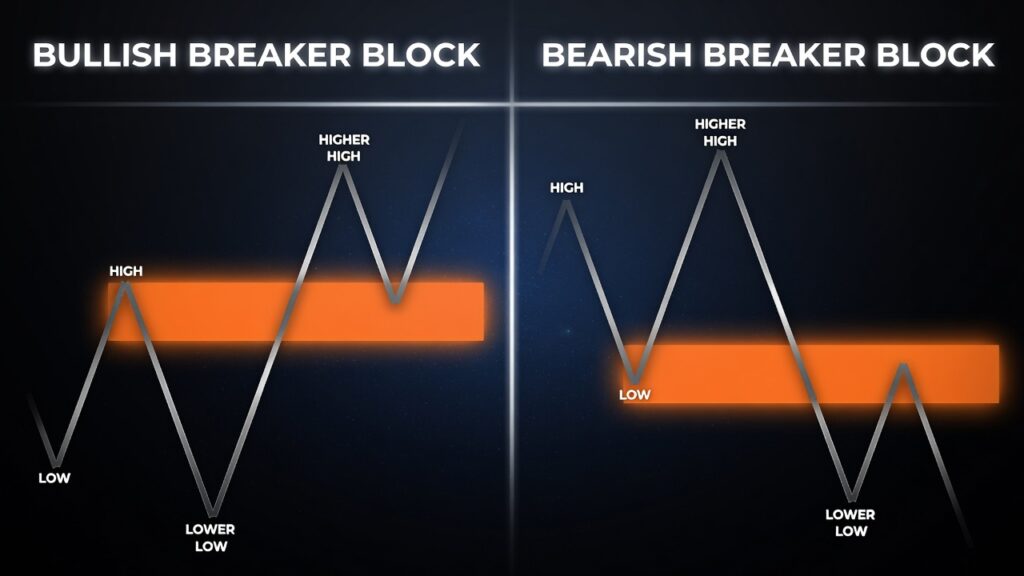
A breaker block forms when an existing order block fails to hold and price breaks through the swing point it was protecting. That failure is confirmed by a break of structure (BOS) in the opposite direction. Once the order block has been invalidated this way, the zone doesn’t just disappear — it flips roles.
Think of it like a support level that gets broken and then becomes resistance on the retest. A breaker block works the same way, except the underlying zone is an order block rather than a simple horizontal line.
Bullish Breaker Block
- Forms when a bearish order block (the last up-close candle before a drop) fails — price breaks back above the recent swing high instead of continuing down.
- That failed bearish order block flips into a bullish breaker block: a zone where traders now look for support and long entries.
Bearish Breaker Block
- Forms when a bullish order block (the last down-close candle before a rally) fails — price breaks back below the recent swing low instead of continuing up.
- That failed bullish order block flips into a bearish breaker block: a zone where traders now look for resistance and short entries.
How to Identify a Breaker Block, Step by Step
1. Mark the order block. Identify the last opposing candle before a strong impulse move, the same way you would for a normal order block trade.
2. Watch the swing point behind it. Every order block is protecting a recent swing high or swing low.
3. Wait for a break of structure through that swing point in the opposite direction. This is what invalidates the order block.
4. Mark the breaker zone. Use the candle range of the failed order block (or the full leg that failed) as your new breaker block zone.
5. Wait for price to retrace back into the breaker zone before considering an entry — don’t chase the move that created the breaker.
6. Look for confirmation on a lower timeframe (a smaller BOS or rejection wick) inside the zone before entering.
| Tip: Breaker blocks tend to be more reliable on higher timeframes (H1, H4, Daily). A 1-minute breaker block can form and fail dozens of times a day and is mostly noise. |
Breaker Block vs. Order Block: What’s the Difference?
They’re closely related, but not the same thing:
- Order block: a zone that hasn’t been broken yet — it’s the original footprint of institutional orders.
- Breaker block: a zone that has already been broken and confirmed by a BOS, which flips its role from support to resistance (or the reverse).
In short: every breaker block used to be an order block. Not every order block becomes a breaker block — most either hold and work as originally expected, or simply stop being relevant once price moves on.
Common Mistakes Traders Make With Breaker Blocks
1. Marking a breaker block without a confirmed BOS first. If the swing point hasn’t actually broken, you’re still looking at a normal order block, not a breaker.
2. Entering the moment price touches the zone, instead of waiting for a rejection or lower-timeframe confirmation.
3. Using breaker blocks on very low timeframes without any higher-timeframe context.
4. Ignoring the wider trend — breaker blocks work best when they align with the higher-timeframe direction, not against it.
5. Placing stops right at the edge of the zone instead of beyond it, which often gets triggered by normal wick noise.

Best Practices for Trading Breaker Blocks
- Confirm the break of structure first — the BOS is what makes a breaker block valid, not just a broken-looking zone.
- Combine breaker blocks with other confluence, such as fair value gaps or liquidity sweeps, rather than trading them in isolation.
- Keep risk small (1–2% per trade) since breaker blocks are a reactive, retracement-based setup, not a guaranteed reversal signal.
- Track your breaker block trades in a trading journal to see which timeframes and instruments actually work for your style.
Frequently Asked Questions
Q: What is a breaker block in trading?
A: A breaker block is a former order block that has failed after price broke through the swing point it was protecting. Once broken, the zone flips roles — a failed bearish order block becomes a bullish breaker block, and a failed bullish order block becomes a bearish breaker block.
Q: What’s the difference between an order block and a breaker block?
A: An order block is a zone that hasn’t been broken yet. A breaker block is what’s left after that order block fails and a break of structure confirms the reversal, flipping the zone’s role from support to resistance or vice versa.
Q: Is a breaker block bullish or bearish?
A: It can be either. A bullish breaker block forms after a bearish order block fails to the upside; a bearish breaker block forms after a bullish order block fails to the downside.
Q: How do you trade a breaker block?
A: Most traders wait for price to retrace back into the breaker zone after the break of structure, then look for confirmation — such as a rejection wick or a smaller BOS on a lower timeframe — before entering in the new direction.
Q: Do breaker blocks work in forex and futures?
A: Yes. Breaker blocks are a price-action concept, so they can be applied to any liquid market, including forex pairs, indices, and futures — though results vary by instrument and timeframe, so it’s worth testing on the specific markets you trade.
Ready to Put Concepts Like This Into Practice?
Understanding market structure, order blocks, and breaker blocks is one thing — applying them consistently under real trading conditions is another. Maven Trading gives funded traders a simulated account, a supportive community, and the tools to test strategies like this without risking personal capital beyond a challenge fee. Choose your challenge to get started, or join the conversation in our Discord.
Note: Maven Trading provides simulated funded accounts and educational content only. This article is for educational purposes and is not financial advice.