Fair Value Gap Strategy: How to Trade FVGs in Forex - Maven Trading
Written by Seb on February 25, 2026.Introduction
The Fair Value Gap strategy is a popular Forex trading method that focuses on price imbalances created by strong momentum moves. When price moves aggressively in one direction, it often leaves behind a liquidity gap. The Fair Value Gap strategy helps traders identify these gaps and trade the retracement back into them.
In this article, we will be covering:
- What a Fair Value Gap (FVG) is?
- Why Do FVGs Matter?
- Step-by-Step Method to Trade FVGs Effectively
- How to identify FVGs on a chart
- Common mistakes traders make with FVGs
- Best practices for managing risk when trading FVGs
What is a Fair Value Gap?
A Fair Value Gap (FVG) is a specific zone on a candlestick chart that forms after a strong price move. The concept of FVG is a practical one, as it develops over a sequence of three candles:
- Candle 1: a normal candle.
- Candle 2: a strong move up or down (the impulse).
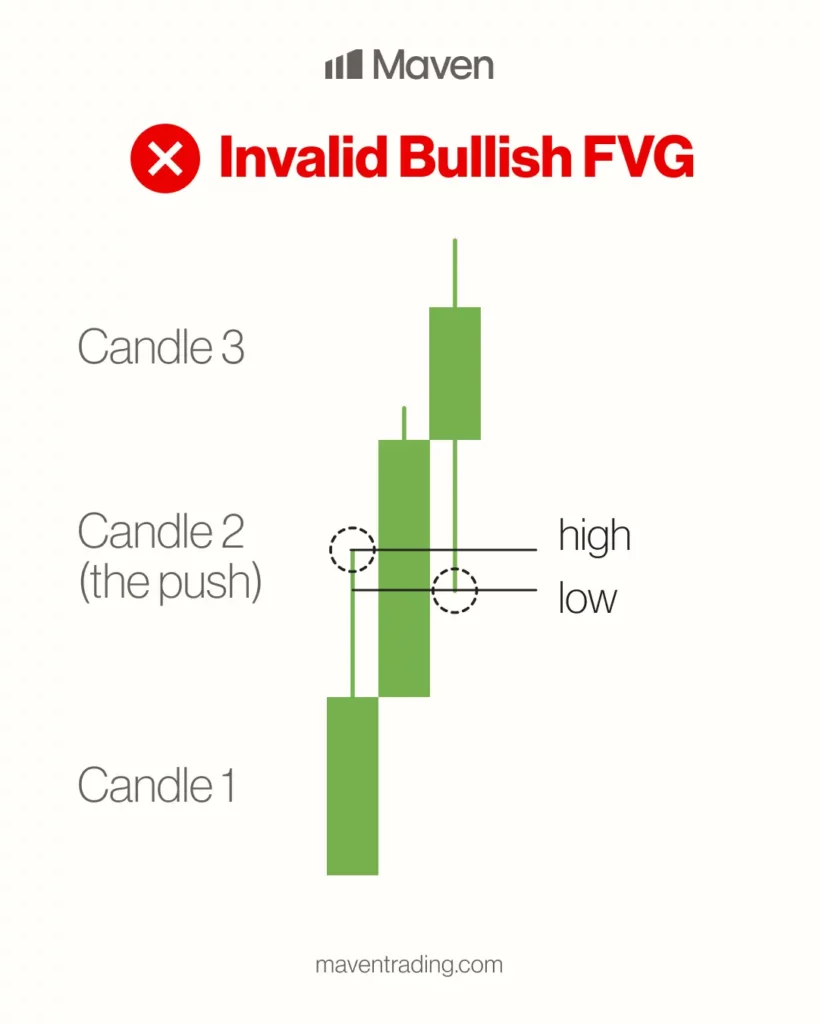
- Candle 3: Check for space between Candle 1 and Candle 3. If their wicks don’t overlap, you’ve found a fair value gap.
Let’s put that into context regarding a bullish and bearish market.
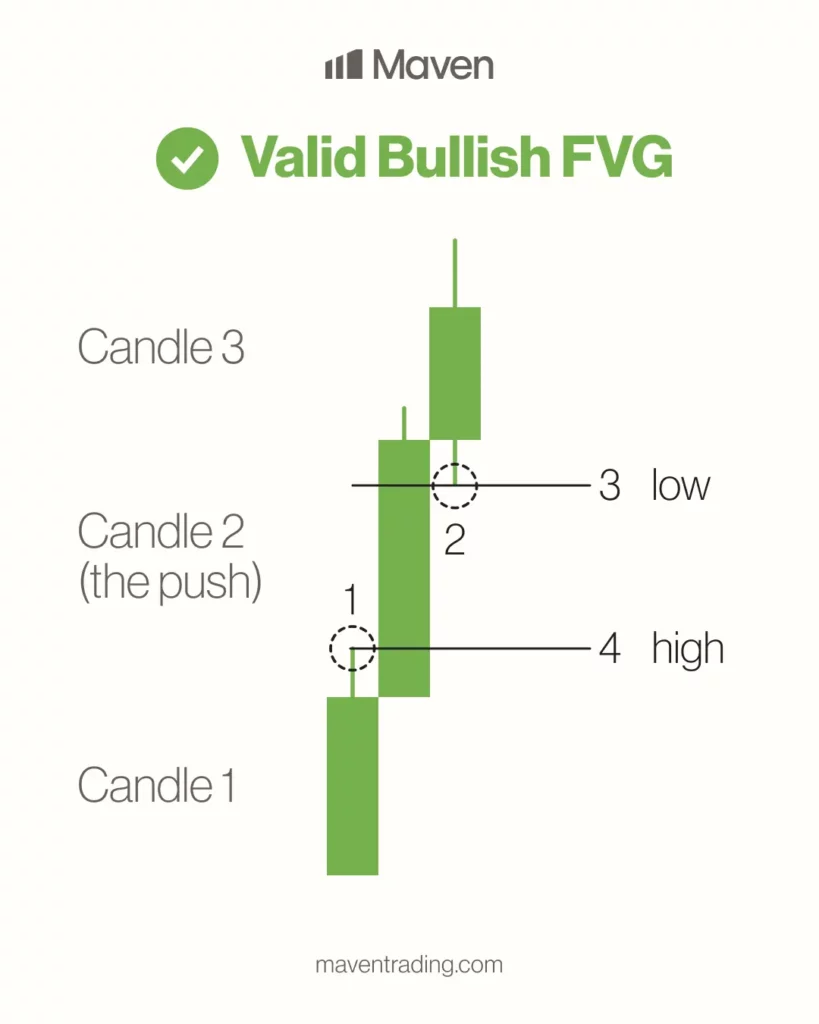
In a bullish market, the middle candle pushes up hard. The gap forms between the Candle 1’s high and Candle 3’s low. Price often retraces into this gap before resuming momentum.
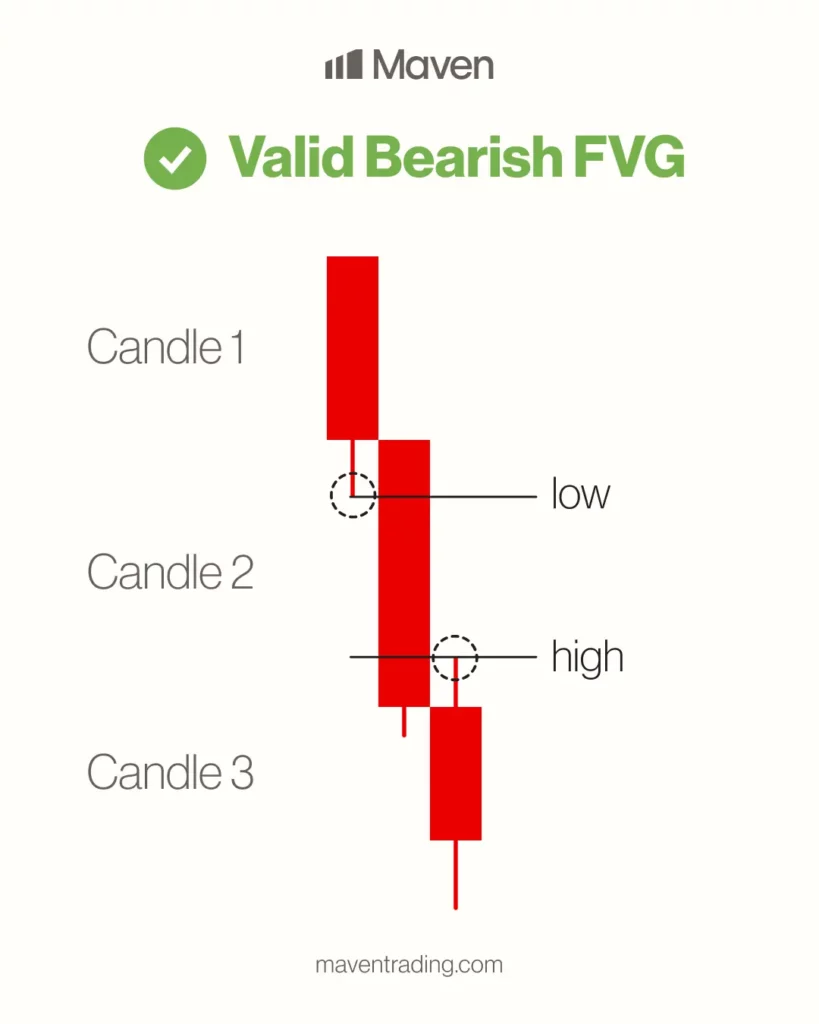
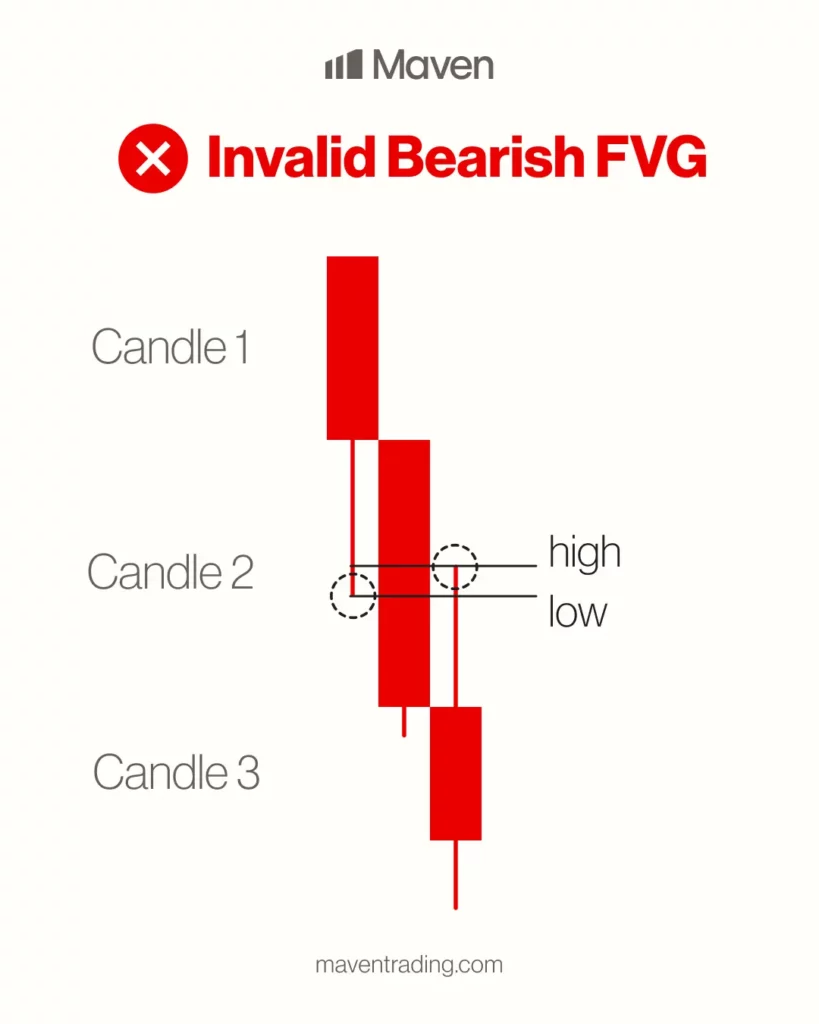
In a bearish market, the middle candle drops fast, and a gap forms between Candle 1’s low and Candle 3’s high. Price often pulls back to this area before dropping again.
Why Do FVGs Matter?
Fair Value Gaps occur when large buy or sell orders, often from institutions or algorithms, push prices strongly in one direction. Because the market lacks enough opposite-side liquidity to absorb these orders, price jumps instead of moving smoothly. This creates a void on the chart where little or no trading took place. Traders pay attention to these gaps because they highlight areas of inefficiency that may later attract price back, offering potential trading opportunities.
Example:
Imagine USD/JPY is trading between 145.00 and 146.00. You buy at 145.00, planning to sell at 146.00. Suddenly, important news strengthens the US dollar, and the price jumps straight to 147.00 because sellers don’t step in immediately, and the market moves quickly without trading in the space between 146.00 and 147.00. This creates a Fair Value Gap. Later, if the price returns to this zone, traders often see it as an area of interest. New orders may be triggered there because the market may “fill” the previous imbalance before continuing its trend.
| Tip: Always confirm on higher timeframes first (H1, H4, Daily). Small gaps on the 1-minute chart are often just noise. |
How to Trade the Fair Value Gap Strategy Step by Step
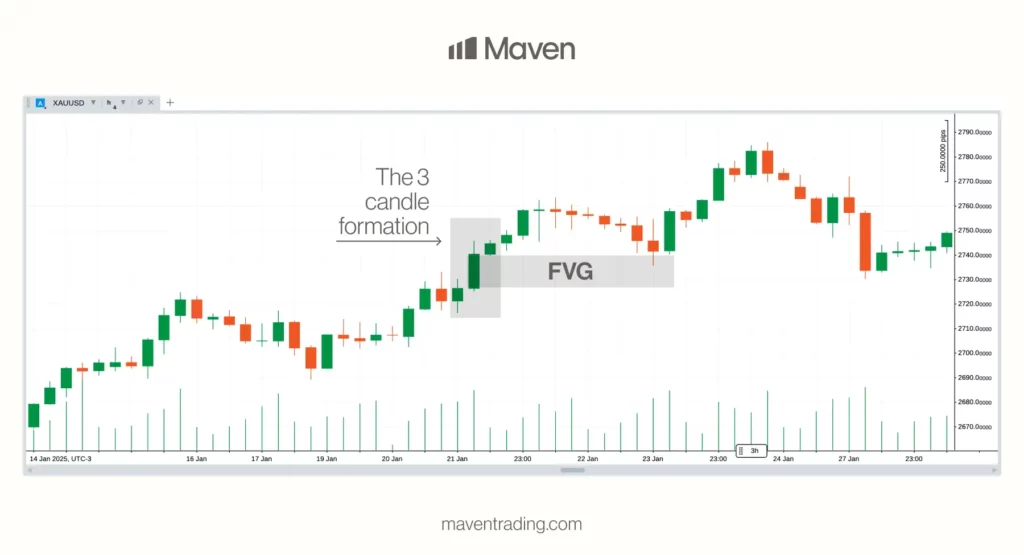
- Mark the Gap: Highlight the imbalance zone between Candle 1 and Candle 3.
- Wait for the Retrace: Don’t chase the impulse candle. The trade comes when price returns to the FVG zone.
Here is what it looks like on a real chart:
Entry Options
- Conservative: enter at the edge of the FVG.
- Aggressive: enter in the middle of the FVG.
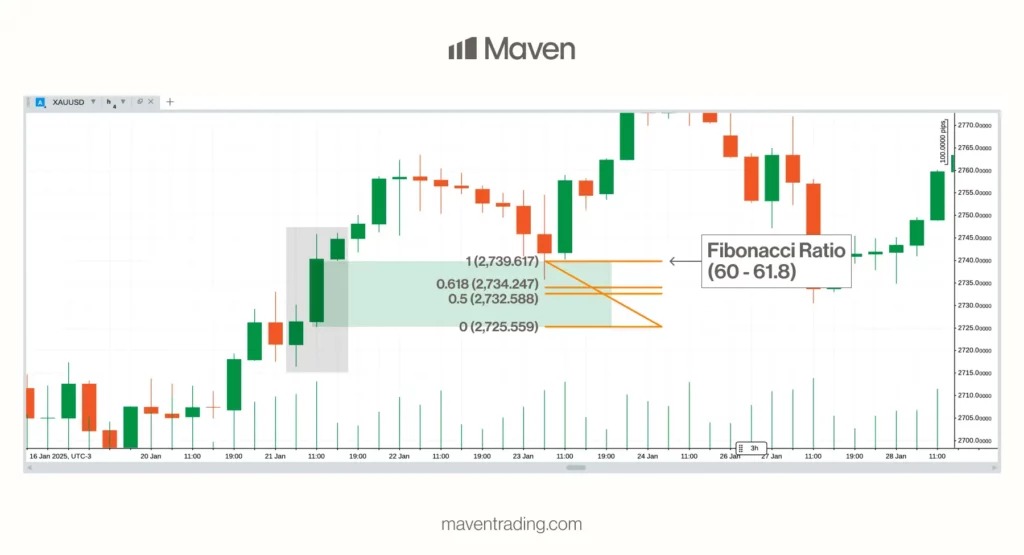
- Advanced: combine with Fibonacci retracement (0.50 – 0.618) for higher accuracy.
Stops and Targets
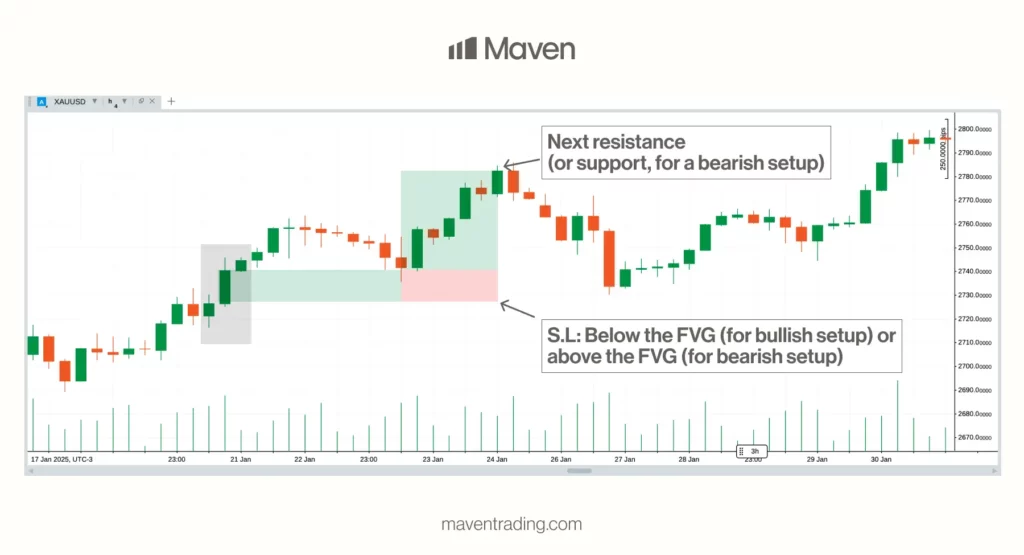
- Stop-Loss: You can just beyond the FVG (below for longs, above for shorts).
- Take-Profit: You can put it at the next key support/resistance or a set risk-to-reward (minimum 1:3).
Invalidation Rule
- If the price doesn’t revisit the gap within 5-7 candles, skip it. Fresh setups appear all the time.
| N.B.: FVGs form from a three-candle setup, which makes them easy to spot and quick to appear on the chart. The trade-off is that this simplicity can reduce their reliability. Traders often use them alongside other signals or market structure tools to confirm whether the gap is likely to hold or fail. |
Common Mistakes When Using the Fair Value Gap Strategy
While FVGs are powerful tools, beginners often misuse them. Here are the big mistakes:
- Trading Every Gap: Not all FVGs are worth trading. Smaller gaps on low timeframes often get ignored by bigger players.
- Forcing Entries: Jumping into a trade just because an FVG forms, instead of waiting for confirmation (like structure shifts).
- Ignoring Market Context: Using FVGs in isolation without considering trend direction, key levels, or higher timeframe zones.
- Poor Risk Placement: Setting stops inside the gap instead of just beyond it, which often gets you worked out.
- Overleveraging: Treating FVGs as “guaranteed setups” and risking too much. Even clean gaps fail if overall conditions don’t support the trade.
- Skipping Journaling: Not tracking which types of FVGs (session, timeframe, size) actually work best for your style.
Best Practices for Managing Risk when Trading FVGs
- Focus on higher timeframe FVGs for more reliable signals.
- Always pair FVGs with risk management, never risk more than 1–2% per trade.
- Track your results in a trading journal to see if FVG setups fit your style.
- Be patient. The power of FVGs lies in waiting for price to come back to you.
Conclusion
Like most strategies, fair value gaps are not magic; they work best when combined with other concepts such as trend direction, break of structure, or even liquidity sweeps. They highlight where price may return after moving too fast, but keep in mind, some gaps are never tested at all. This makes FVGs a tool to add to an existing strategy. Maven takes it further by giving you guidance and real-time support to apply strategies like this in live markets. If you’re not in our Discord, join today. And if you don’t yet have a proper trading account to practice these setups, you can start here.