NFP (Non-Farm Payroll) Explained: What It Means for Traders - Maven Trading
Escrito por Seb em June 2, 2025.Once a month, a single US jobs number can move the dollar, gold and most major forex pairs within seconds. That number is NFP, and if you trade forex, especially on a funded or challenge account, you need to know when it lands, why it moves price so violently and how to keep it from wrecking your account.
Quick answer: NFP (Non-Farm Payrolls) is the monthly US jobs figure released at 8:30 a.m. Eastern Time, usually on the first Friday of the month. It often causes sharp price spikes, wider spreads and slippage in the dollar, gold and major pairs, so most risk-aware traders either stand aside until volatility settles or trade it with reduced size and a plan set in advance.
In this guide
- What is the NFP report and why does it matter?
- How does NFP impact the market?
- What happens to spreads, slippage and liquidity at the release
- How to trade NFP (without losing your mind or your account)
- NFP pre-release checklist
- Conclusion
- FAQ
1. What is the NFP report and why does it matter?
NFP stands for Non-Farm Payrolls. It is the headline number in the US Employment Situation report, published monthly by the Bureau of Labor Statistics, and it shows how many jobs the US economy added or lost in the previous month.
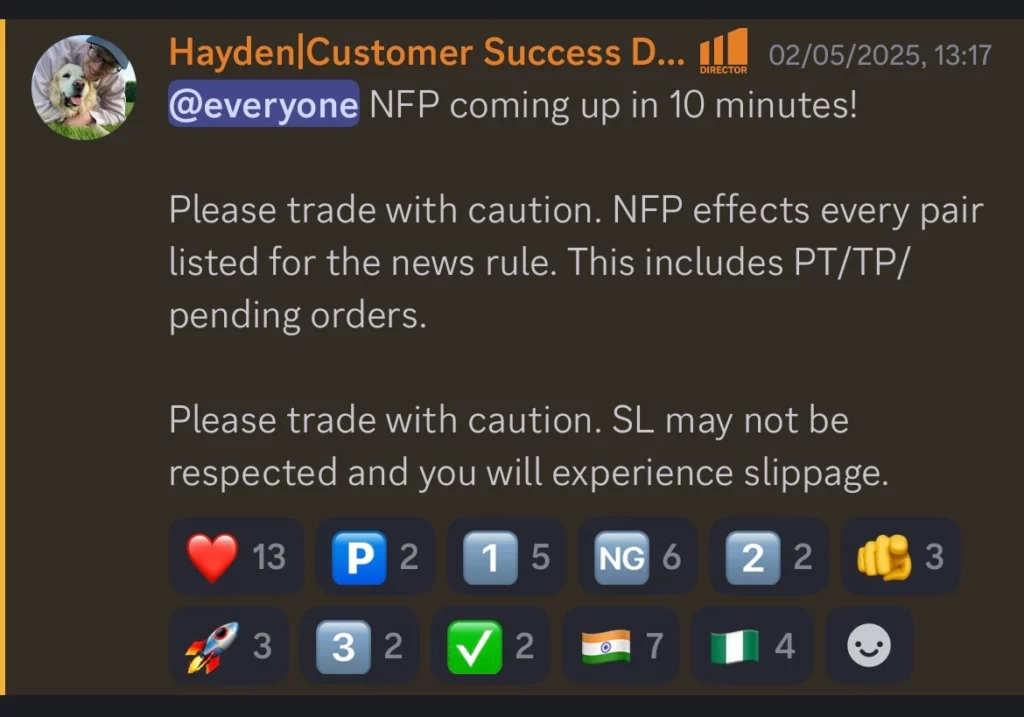
It is called “non-farm” because it excludes farm workers, private household employees and employees of non-profit organizations. The report is normally released on the first Friday of the month at 8:30 a.m. Eastern Time (ET). Holidays can shift the date, so always confirm it on an economic calendar.
Alongside the headline jobs number, the report includes several other figures traders watch closely:
- Unemployment rate: the share of the labor force without a job and actively looking for one.
- Average hourly earnings: wage growth, which feeds directly into inflation expectations.
- Labor force participation rate: the share of working-age people who are employed or looking for work.
- Average weekly hours: how many hours employees are working.
Why does it matter? Jobs drive spending, and spending drives the US economy. Strong hiring usually signals a healthy economy, while weak numbers can point to a slowdown. Because the US Federal Reserve watches the labor market closely when setting interest rates, NFP shapes expectations for future rate decisions. If you want the rate side of the story, see our explainer on FOMC and how it impacts markets.
2. How does NFP impact the market?
NFP is one of the clearest monthly reads on the strength of the US economy, which makes it one of the biggest scheduled market movers in forex.
As a general rule, a strong report can raise expectations of tighter monetary policy and tends to support the US dollar. A weak report can do the opposite. Because the dollar sits on one side of most major pairs, the reaction spreads quickly through EUR/USD, GBP/USD, USD/JPY and other majors and minors, as well as gold and US index CFDs. These markets can move sharply within seconds of the release.
The key detail many newer traders miss: the market does not react to the number itself so much as to the gap between the number and what analysts forecast. A strong figure that matches expectations may barely move price, while a modest miss can trigger a large swing. Revisions to the previous month’s figure and the wage data can pull price in a different direction from the headline, which is one reason the first move after NFP often reverses.
3. What happens to spreads, slippage and liquidity at the release
Just before and after the release, liquidity thins as liquidity providers pull or widen their quotes. Three things tend to follow:
- Spreads widen. The cost of entering and exiting a trade rises, sometimes sharply for a few seconds.
- Slippage increases. Stop-losses and market orders can fill away from the price you set.
- Price whipsaws. Candles can spike one way and then reverse through the same range within minutes, often sweeping stops placed around obvious levels.
This is the same liquidity dynamic covered in our guides to forex liquidity and trading conditions and liquidity grabs, compressed into a few seconds.
The practical consequence: a stop sized for a 10-pip risk can effectively become a 25-pip loss. If your position size assumes your stop will fill exactly where you placed it, NFP can break that assumption.
4. How to trade NFP (without losing your mind or your account)
If you are trading a prop firm challenge or funded account, NFP needs a plan. Here is how to approach it.
Know the rules (especially if you’re trading funded)
At Maven, news trading rules apply around high-impact releases like NFP: there is a window of two minutes before and two minutes after the release. Other firms set different windows or restrictions, so never assume one firm’s rule applies to another. Check the current news policy in our FAQ before you plan an NFP trade, and if anything is unclear, ask support before the release, not after.
Check your limit orders
Resting limit and pending orders can get filled during the release spike at prices you never intended to trade. Review every open order before NFP and cancel or adjust anything that could be triggered in the chaos. Avoid entering just before or just after the release, when price action is at its most erratic.
Follow the news in real time
Use an economic calendar such as Forex Factory or the TradingView economic calendar to confirm the release time, see the forecast and previous figures, and watch the actual number come in. Convert 8:30 a.m. ET into your platform’s server time so you are not caught off guard. NFP also lands during the New York session, already one of the most volatile windows of the day, as explained in our forex trading sessions guide.
Manage risk like a pro
You have three sensible options: stay out of the market until volatility settles, trade with a reduced lot size, or widen your stop to fit the expected volatility. If you widen your stop, cut your size so the amount at risk stays the same. Wider stop plus same lot size equals a bigger loss.
On a challenge, the biggest NFP risk is often your daily loss limit, not the individual trade. A single slipped stop can use up a large share of your daily allowance. Before the release, check how much of the limit you have already used. If it is more than half, consider skipping the event entirely.
Tip: Decide your NFP plan the day before. Deciding in the 30 seconds after the release is how mistakes are made.
Fade or follow?
Once the initial reaction has played out, you face a choice: fade the move if it looks like a fakeout that swept liquidity, or follow it if price is building structure in that direction. One simple approach is to wait for the first 15-minute candle after the release to close, mark its high and low, and only act on a clear break and retest.
What about trading the spike itself? Some traders place pending orders on both sides of price before the release (a straddle), hoping to catch the breakout. It is the riskiest way to trade NFP: widened spreads can trigger both orders, slippage can turn a defined risk into a larger one, and orders placed close to the release can run into the news-trading window.
5. NFP pre-release checklist
- Confirm the release date and time on an economic calendar and convert it to your platform’s server time.
- Re-read Maven’s news trading rules for your account type.
- Choose your approach the day before: stand aside, trade the aftermath or trade with reduced risk.
- Check how much of your daily loss limit is already used.
- If you widen your stop, cut your size so the money at risk stays the same.
- Cancel or adjust any resting orders that could fill during the spike.
- Afterwards, log the trade, including the spread and slippage you actually saw.
6. Conclusion
NFP is a monthly pulse check on the US economy, and it can move markets around the world in seconds. It does not have to be a threat to your account. Know when it lands, know your firm’s rules, respect what it does to spreads and slippage, and decide your plan before the number hits. Sometimes the best NFP trade is no trade at all.
7. FAQ
NFP stands for Non-Farm Payrolls, the headline jobs figure in the monthly US Employment Situation report published by the Bureau of Labor Statistics.
NFP is normally published at 8:30 a.m. ET on the first Friday of the month, but holidays can change the date, so check an economic calendar.
US dollar pairs such as EUR/USD, GBP/USD and USD/JPY usually react most, along with gold and US index CFDs.
Maven applies a news trading window around high-impact releases like NFP. Check the current rule in the FAQ before you plan a trade, and remember that wide spreads and slippage raise the risk to your daily loss limit.
The first spike happens in thin liquidity and often sweeps stops. Once traders digest the full report, including revisions and wage data, price frequently retraces or reverses.
Disclaimer: This article is for educational purposes only and is not financial advice. Trading forex and CFDs carries a high level of risk. Maven Trading provides simulated trading accounts, and past performance does not guarantee future results. Always read the specific rules for your account.