AI Trading in 2026: What It Means for Retail Forex Traders | Maven
Escrito por Emma em August 23, 2026.Algorithmic and AI trading systems now execute a large share of forex and CFD volume, running strategies in microseconds and reacting to headlines faster than any human can read them. If you’re evaluating for a funded account, it’s worth knowing exactly what that does, and doesn’t, change about your own edge, alongside common prop firm trading mistakes and how to backtest a strategy properly.
Quick answer: AI hasn’t made retail trading impossible, it’s changed what retail traders need to be good at, shifting the edge from speed to discipline and risk management.
1. What “AI trading” actually means in 2026
3. Where retail traders still have an edge
4. Should you add automation to your own trading?
5. What this means for prop firm challenges
6. Common mistakes traders make with AI trading tools
7. FAQ
What “AI Trading” Actually Means in 2026
Institutional desks and quant funds use machine-learning models to parse news sentiment, detect microstructure patterns, and execute in fractions of a second. Retail-facing “AI trading” tools are a different animal: signal generators, auto-journaling apps, and risk-management bots that sit on top of a trader’s own decisions rather than replacing them.
Conflating the two leads to bad expectations. A retail trader isn’t racing a hedge fund’s server farm, they’re navigating a market that farm helps shape. The practical question isn’t “can I out-code an algorithm,” it’s “how do I trade well in a market where algorithms set a large share of the short-term price action.”
Where Algorithms Win
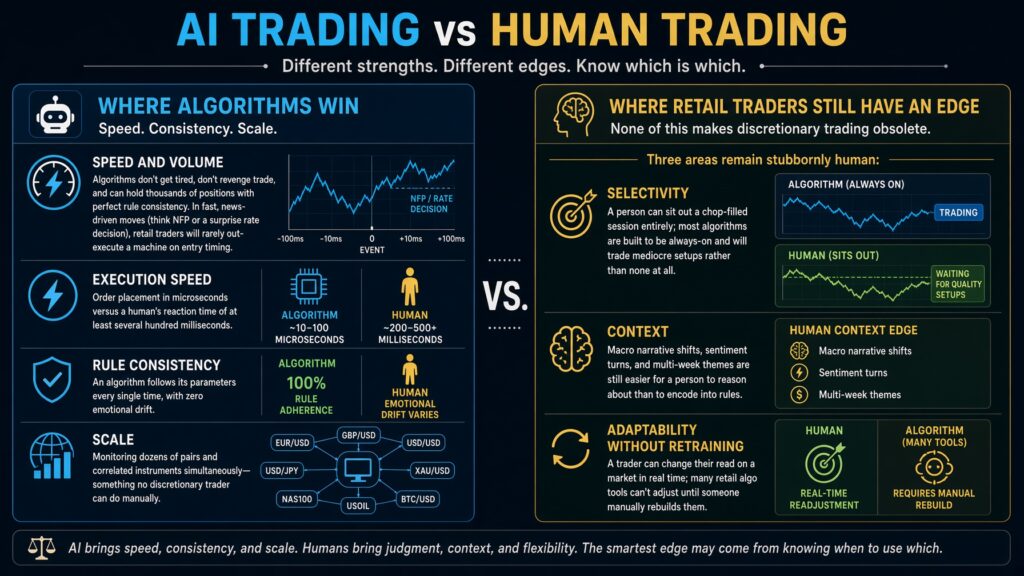
Speed and volume. Algorithms don’t get tired, don’t revenge trade, and can hold thousands of positions with perfect rule consistency. In fast, news-driven moves, think NFP or a surprise rate decision, retail traders will rarely out-execute a machine on entry timing.
- Execution speed: order placement in microseconds versus a human’s reaction time of at least several hundred milliseconds.
- Rule consistency: an algorithm follows its parameters every single time, with zero emotional drift.
- Scale: monitoring dozens of pairs and correlated instruments simultaneously, something no discretionary trader can do manually.
Where Retail Traders Still Have an Edge
None of this makes discretionary trading obsolete. Three areas remain stubbornly human:
- Selectivity: a person can sit out a chop-filled session entirely; most algorithms are built to be always-on and will trade mediocre setups rather than none at all.
- Context: macro narrative shifts, sentiment turns, and multi-week themes are still easier for a person to reason about than to encode into rules.
- Adaptability without retraining: a trader can change their read on a market in real time; many retail algo tools can’t adjust until someone manually rebuilds them.
Should You Add Automation to Your Own Trading?
You don’t need to build a trading bot to benefit from automation. The highest-leverage use of “AI” for most funded traders is narrow and boring: automated stop-losses, daily-loss-limit alerts, and journaling tools that flag emotional patterns, like a string of trades taken minutes after a loss. These reduce the two things that actually sink most accounts, overtrading and revenge trading, more reliably than a black-box signal service.
Full automation, letting an EA or bot trade your account unsupervised, is a different decision, and one that carries its own risk: most prop firms restrict or prohibit third-party account management and undisclosed automated systems, so check your challenge rules before plugging anything in.
| Tip: Before adding any automated tool to a live evaluation, confirm it’s allowed under your specific challenge rules. “Automation” and “third-party management” are treated very differently from firm to firm. |
What This Means for Prop Firm Challenges
Evaluation rules (daily loss limits, consistency rules, max drawdown) are, in effect, a forcing function for the discipline that beats algorithms at their own game. A trader who treats those rules as guardrails rather than obstacles is already doing the one thing most retail accounts fail to do. It’s the same discipline covered in our guide to common prop firm trading mistakes, just applied to a market that now moves faster than it did five years ago.
Common Mistakes Traders Make With AI Trading Tools
- Treating a signal service as a strategy rather than one input among several.
- Assuming a backtested bot will behave the same in live, slower or faster market regimes without re-validation.
- Running an automated tool on a funded account without checking whether the firm’s rules classify it as prohibited third-party management.
- Chasing “AI” branding on a tool without asking what specific, verifiable edge it actually provides.
FAQ
Is AI trading better than manual trading?
Neither is universally better; AI wins on speed and rule-following, while humans still add value through context and selectivity.
Can I use an EA or trading bot on a funded account?
Only if your prop firm’s rules explicitly allow it, many restrict automated or third-party-managed trading, so check your specific challenge terms first.
Will AI replace retail forex traders?
Unlikely in the near term. It has raised the bar on execution speed but hasn’t reduced the value of judgment, risk control, and discipline, the areas where most retail traders still lose money regardless of tools.
This article is for educational purposes only and does not constitute financial or investment advice. Maven Trading provides simulated trading evaluations and does not offer trading on live markets.